Walk from a point in any direction and the heights you pass make an ordinary curve. Its slope is the directional derivative. For a differentiable function it is one dot product, the gradient times the direction, in any number of dimensions.
M05.3.1L2 Intermediate25 minIn review (what this means)
The maths and code on this page are checked by automated tests on every change, but an independent reader has not signed it off yet. Spot a mistake or a confusing step? Tell us.
Define the directional derivative of a function of n inputs along a unit vector as the slope of a slice at zero.
Derive the formula slope equals gradient dot direction from the linear approximation of a differentiable function.
Read a directional derivative as the signed length of the gradient’s shadow on the direction, and compute it in any dimension.
Explain with x squared y over (x to the fourth plus y squared) why slopes in every direction do not make a function differentiable.
Check a directional derivative against a central difference along the direction.
The question
A model with a million weights takes a training step: every weight moves at once, in one particular direction. How fast does the loss change as the model sets off that way? The partial derivatives give the slope along each axis, one weight at a time. Can they also give the slope along a direction that is no axis at all?
Intuition
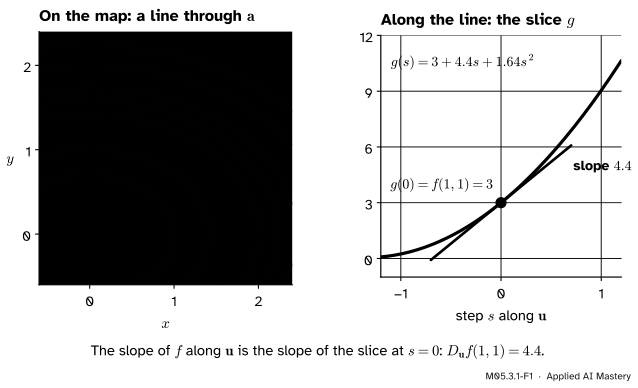
Stand at a point \(\vect{a}\) on the map of a function \(f\) and choose a direction, a vector \(\vect{u}\) of length 1. Walk along the straight line \({\vect{a} + s\,\vect{u}}\). The heights you pass make an ordinary function of one number, the slice \({g(s) = f(\vect{a} + s\,\vect{u})}\) of M05.1.3. Its slope where you stand, at \({s = 0}\), is the slope of \(f\) in the direction \(\vect{u}\): the directional derivative, written \({D_{\vect{u}} f(\vect{a})}\).
M05.3.1-F1
The running bowl \({f(x, y) = x^2 + 2y^2}\) at \({\vect{a} = (1, 1)}\), in the direction \({\vect{u} = (0.6, 0.8)}\). On the map the direction is a line through the point (left). Along that line \(f\) is an ordinary curve (right), and its slope at \({s = 0}\) is the slope of \(f\) in that direction, 4.4.
For the running bowl the slice along \({\vect{u} = (0.6, 0.8)}\) from \({(1, 1)}\) is a parabola, \({g(s) = 3 + 4.4s + 1.64s^2}\), so the slope is 4.4. The two partial derivatives of M05.2 are the special cases where \(\vect{u}\) points along an axis. This lesson shows that you never need to build the slice: the gradient already knows the slope in every direction, and one dot product reads it off.
Build it up
Step 1. Why the direction has length 1. Walk along \({2\vect{u}}\) instead of \(\vect{u}\) and you cover the same line twice as fast, so the slope per unit of \(s\) doubles. A slope should belong to the direction alone, so we measure \(s\) as distance on the map. That needs \({\norm{\vect{u}} = 1}\): a unit vector. The direction \({(3, 4)}\) becomes \({(3, 4)/5 = (0.6, 0.8)}\), since \({\sqrt{9 + 16} = 5}\).
Step 2. The slice, by hand. On the line, \({x = 1 + 0.6s}\) and \({y = 1 + 0.8s}\). Put them into \({x^2 + 2y^2}\) and expand each square:
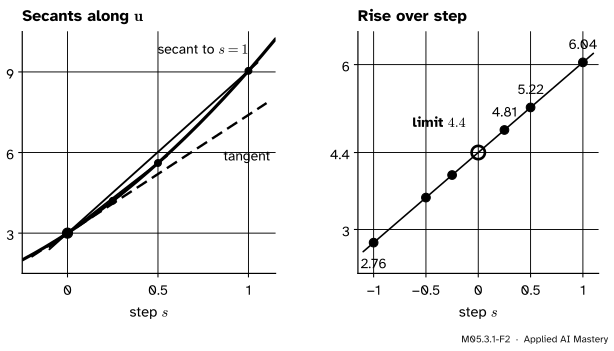
For \({s = 1}\), 0.5 and 0.25 this is 6.04, 5.22 and 4.81. As the step shrinks, the secant lines turn into the tangent and the ratio settles on 4.4.
M05.3.1-F2
The secant from \({s = 0}\) to a nearby point has slope \({4.4 + 1.64s}\). The shorter the step, the closer it is to 4.4, the slope of the tangent.
Step 4. Where 4.4 comes from. At \({(1, 1)}\) the gradient of the bowl is \({(2x, 4y) = (2, 4)}\). Multiply it entry by entry with the direction and add: \({2 \times 0.6 + 4 \times 0.8} = {1.2 + 3.2} = {4.4}\). The same number. The next section shows that this is no accident.
The formal statement
NoteDefinition: directional derivative
Let \({f : \R^n \to \R}\), let \(\vect{a}\) be a point and \(\vect{u}\) a unit vector. The directional derivative of \(f\) at \(\vect{a}\) in the direction \(\vect{u}\) is
with a remainder whose ratio \({r(\vect{h}) / \norm{\vect{h}}}\) tends to 0 as \(\vect{h}\) shrinks to \(\vect{0}\). Take the step \({\vect{h} = s\vect{u}}\) with \({s \neq 0}\). Move \({f(\vect{a})}\) to the left and divide by \(s\):
The first term on the right does not depend on \(s\). For the second, \({\norm{s\vect{u}} = \abs{s}}\) because \(\vect{u}\) has length 1, so \({\abs{r(s\vect{u}) / s}} = {\abs{r(s\vect{u})} / \norm{s\vect{u}}}\). As \({s \to 0}\) the step \({s\vect{u}}\) shrinks to \(\vect{0}\) and this ratio tends to 0. So the left side has a limit, and it is \({\nabla f(\vect{a})\T\vect{u}}\). \(\square\)
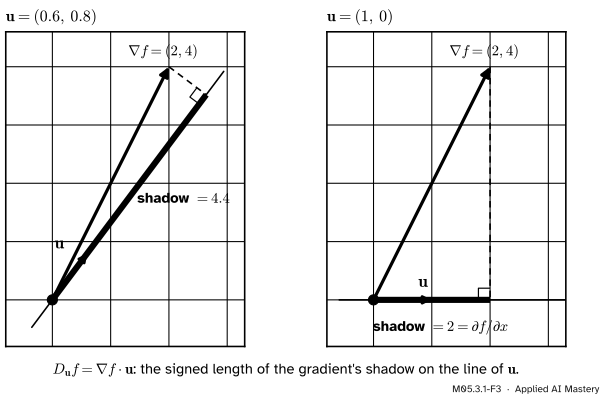
The picture. Because \({\norm{\vect{u}} = 1}\), the dot product \({\nabla f\T\vect{u}}\) is the signed length of the shadow that the gradient casts on the line of \(\vect{u}\) (the scalar projection of M02.3.4). A long shadow means a steep climb; a shadow pointing backwards means descent.
M05.3.1-F3
The directional derivative is the gradient’s shadow on the direction. Along \({(0.6, 0.8)}\) the shadow of \({(2, 4)}\) is 4.4 long; along the \(x\) axis it is 2, the partial derivative in \(x\).
Two consequences follow at once. Reversing the direction reverses the slope, \({D_{-\vect{u}} f = -D_{\vect{u}} f}\), since the dot product is linear. And the slope in a mixed direction is a weighted sum of the partial derivatives, with the entries of \(\vect{u}\) as weights.
Some books, Boyd and Vandenberghe among them, call \({\nabla f\T\vect{v}}\) the directional derivative for any vector \(\vect{v}\), not only a unit one. That number is the rate of change per unit of \(s\) along \({\vect{a} + s\vect{v}}\), which is \({\norm{\vect{v}}}\) times our slope.
Go deeper: a formula that works in every direction is still not enough
Let \({h(x, y) = 1}\) on the parabola \({y = x^2}\) (except at the origin) and \({h = 0}\) everywhere else. A line \({y = mx}\) through the origin meets the parabola only where \({x^2 = mx}\), that is at \({x = 0}\) and \({x = m}\), and the axis \({x = 0}\) meets it only at the origin. So on every line, near the origin, \(h\) is 0: every directional derivative at the origin exists and equals 0, which is \({\nabla h(\vect{0})\T\vect{u}}\) with \({\nabla h(\vect{0}) = \vect{0}}\). Yet \(h\) is not even continuous there, since it equals 1 at points of the parabola as close to the origin as you like. Lines cannot see what happens along curves; differentiability is a statement about every way of approaching the point at once.
Worked example
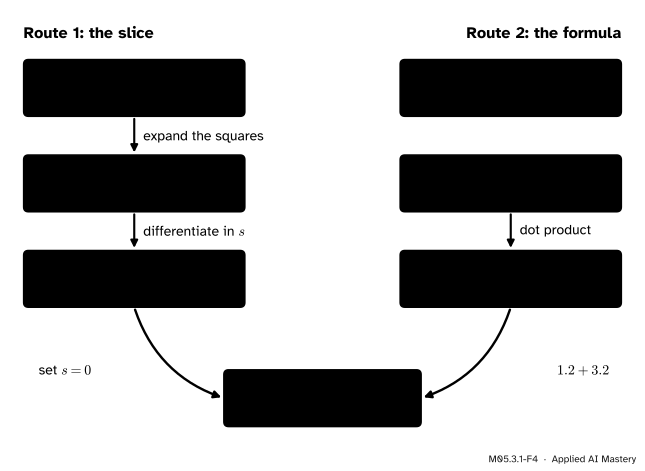
The bowl at \({(1, 1)}\) along \({(3, 4)/5}\). Route 1 builds the slice, as in Step 2, and differentiates it: \({g'(s) = 4.4 + 3.28s}\), so \({g'(0) = 4.4}\). Route 2 takes the gradient \({(2, 4)}\) and the unit direction \({(0.6, 0.8)}\) and forms one dot product, \({1.2 + 3.2 = 4.4}\).
M05.3.1-F4
Two routes to the same slope. The slice needs algebra that grows with the function; the formula needs only the gradient.
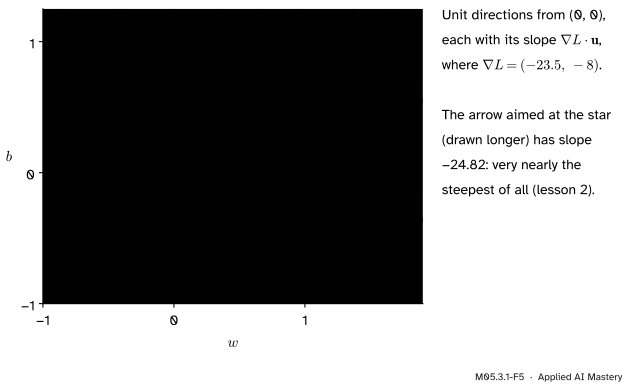
The running loss at the origin. From M05.2.3 the gradient of the running loss is \({(15w + 5b - 23.5,\; 5w + 2b - 8)}\), which is \({(-23.5, -8)}\) at \({(0, 0)}\). Along the \(w\) axis the slope is \(-23.5\); along the \(b\) axis it is \(-8\). The diagonal unit vector \({(1, 1)/\sqrt{2}}\) gives
Backwards, along \({(-1, 0)}\), the loss climbs at 23.5. As a check on the first number, the slice of the loss along the \(w\) axis is \({7.5w^2 - 23.5w + 18.5}\), whose slope at 0 is \(-23.5\).
M05.3.1-F5
Slopes of the running loss at \({(0, 0)}\), each one \({\nabla L\T\vect{u}}\). Heading for the lowest point is almost the steepest way down from here; lesson 2 finds the steepest exactly.
Three inputs. For \({f(x, y, z) = x^2 + 2y^2 + 3z^2}\) at \({(1, 1, 1)}\) the gradient is \({(2x, 4y, 6z) = (2, 4, 6)}\). The direction \({(1, 2, 2)}\) has length \({\sqrt{1 + 4 + 4} = 3}\), so \({\vect{u} = (1, 2, 2)/3}\) and
No picture of a function of three inputs is needed; the dot product works the same in any dimension.
Code
From scratch: the formula against a central difference taken along the direction, which needs only two values of \(f\), whatever the number of inputs.
import numpy as npdef directional(f, a, u, h=1e-6):"""Slope of f at a along u, by a central difference along the line a + s u.""" u = u / np.linalg.norm(u) # a unit vector, alwaysreturn (f(a + h * u) - f(a - h * u)) / (2* h)bowl =lambda p: p[0] **2+2* p[1] **2loss =lambda p: 7.5* p[0] **2+5* p[0] * p[1] + p[1] **2-23.5* p[0] -8* p[1] +18.5bowl3 =lambda p: p[0] **2+2* p[1] **2+3* p[2] **2cases = [("bowl", bowl, [1, 1], [3, 4], [2, 4]), ("loss", loss, [0, 0], [1.4, 0.5], [-23.5, -8]), ("bowl in 3-D", bowl3, [1, 1, 1], [1, 2, 2], [2, 4, 6])]for name, f, a, v, grad in cases: a, v, grad = np.array(a, float), np.array(v, float), np.array(grad, float)print(f"{name:12s} formula {grad @ v / np.linalg.norm(v):9.4f} difference {directional(f, a, v):9.4f}")
bowl         formula    4.4000   difference    4.4000
loss         formula  -24.8216   difference  -24.8216
bowl in 3-D  formula    7.3333   difference    7.3333
The same check on a function of ten inputs, at a random point and in a random direction. Its gradient was worked out by hand: \({2 i\,x_i}\) from each term \({i\,x_i^2}\), plus the sine term’s \({\cos(x_1 x_2)\,(x_2, x_1)}\) in the first two places.
rng = np.random.default_rng(1)n =10weights = np.arange(1, n +1)f10 =lambda x: np.sum(weights * x **2) + np.sin(x[0] * x[1])def grad10(x): g =2* weights * x g[0] += np.cos(x[0] * x[1]) * x[1] g[1] += np.cos(x[0] * x[1]) * x[0]return ga, v = rng.normal(size=n), rng.normal(size=n)u = v / np.linalg.norm(v)print("formula ", grad10(a) @ u)print("difference", directional(f10, a, u))
formula    -5.73997472759745
difference -5.739974728413699
The two agree to six decimal places or better (the exact digits depend on rounding). Now the function of the first pitfall below: the difference quotients along the diagonal settle on \({1/\sqrt{2} \approx 0.707}\), while the formula with its gradient \({(0, 0)}\) would say 0.
def h(x, y):return0.0if x ==0and y ==0else x * x * y / (x **4+ y * y)d = np.array([1.0, 1.0]) / np.sqrt(2)for s in (1e-1, 1e-3, 1e-5):print(f"s = {s:g}: rise over step {h(s * d[0], s * d[1]) / s:.6f}")print("on the parabola y = x^2:", [h(x, x * x) for x in (0.1, 0.01, 0.001)])
s = 0.1:  rise over step 0.703589
s = 0.001:  rise over step 0.707106
s = 1e-05:  rise over step 0.707107
on the parabola y = x^2: [0.5000000000000001, 0.5, 0.4999999999999999]
Explore
This module’s interactive, the direction dial, lives in lesson 3. Drag the point on a contour map and turn the direction slider: the side panel plots \({D_{\vect{u}} f}\) against the angle, and you can watch the slope of this lesson change as the direction turns.
Pitfalls
M05.3.1-F6
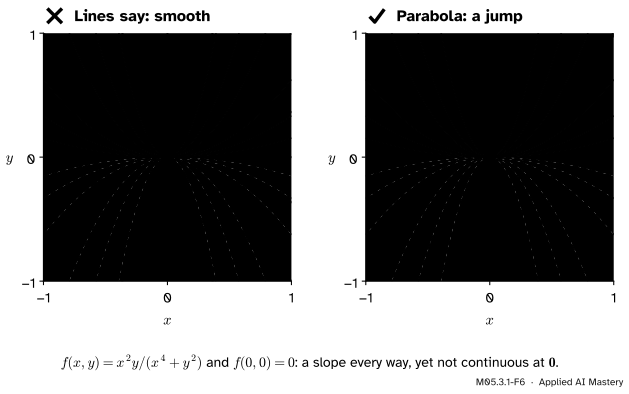
Wrong beside right. Every straight line through the origin gives the function a slope there, yet along the parabola \({y = x^2}\) it stays at \(\tfrac12\) all the way in, while at the origin it is 0.
“It has a slope in every direction, so it is differentiable.”
Take \({f(x, y) = x^2 y / (x^4 + y^2)}\) with \({f(0, 0) = 0}\). Along \({\vect{u} = (a, b)}\) with \({b \neq 0}\),
where the second line cancels \({s^3}\) from top and bottom. Along the \(x\) axis (\({b = 0}\)) \(f\) is 0, so the slope is 0. Every directional derivative exists, but both partial derivatives are 0, so the formula would give 0 in every direction, which is wrong (along the diagonal it is \({1/\sqrt{2}}\)). Worse, on \({y = x^2}\) we get \({f = x^4 / (2x^4) = \tfrac12}\), so \(f\) is not even continuous at the origin. The formula \({\nabla f\T\vect{u}}\) needs differentiability.
“Any arrow will do as the direction.”
With \({\vect{v} = (3, 4)}\) instead of \({(0.6, 0.8)}\), \({\nabla f\T\vect{v} = 6 + 16 = 22}\), five times the true slope 4.4, because \(\vect{v}\) is five units long. Divide by \({\norm{\vect{v}}}\) first, or you are measuring the speed of a walker, not the steepness of the ground.
“The slope tells me how much the loss changes on a step.”
Only for a short step. On the bowl a step of length 1 along \({(0.6, 0.8)}\) raises \(f\) by \({g(1) - g(0) = 6.04}\), not 4.4: the slope describes the tangent, and the curve bends away from it. This is why gradient methods take small steps, controlled by a learning rate (ML01.5).
Check yourself
Recall
1. What is \({D_{\vect{u}} f(\vect{a})}\), in words?
Show answer
The slope of \(f\) at \(\vect{a}\) when you move along the unit vector \(\vect{u}\): the derivative at \({s = 0}\) of the slice \({g(s) = f(\vect{a} + s\vect{u})}\).
2. What is the formula for \({D_{\vect{u}} f}\) when \(f\) is differentiable?
Show answer
\({D_{\vect{u}} f(\vect{a})} = {\nabla f(\vect{a})\T\vect{u}}\), the sum of the partial derivatives weighted by the entries of \(\vect{u}\).
3. Why must \(\vect{u}\) have length 1?
Show answer
So that \(s\) measures distance. A direction of length \(k\) would multiply the slope by \(k\).
4. What is \({D_{\vect{e}_i} f}\)?
Show answer
The partial derivative \({\pd{f}{x_i}}\): moving along the axis \(\vect{e}_i\) changes input \(i\) only.
5. Give a function that has a slope in every direction at a point but is not differentiable there.
Show answer
\({f(x, y) = x^2 y / (x^4 + y^2)}\) with \({f(0, 0) = 0}\), at the origin. Its slope along \({(a, b)}\) is \({a^2/b}\) (0 when \({b = 0}\)), not of the form \({\nabla f\T\vect{u}}\), and it equals \(\tfrac12\) on the parabola \({y = x^2}\).
Exercises
1.★ Find the slope of the running bowl at \({(2, -1)}\) in the direction \({(0.6, -0.8)}\), by the formula and by the slice.
Show solution
The gradient is \({(2x, 4y) = (4, -4)}\), so the slope is \({4 \times 0.6 + (-4) \times (-0.8)} = {2.4 + 3.2} = {5.6}\). By the slice,
2.★★ At \({(w, b) = (1, 0)}\) on the running loss, find the slope along \({(1, 1)/\sqrt{2}}\), and find a unit direction in which the slope is 0.
Show solution
The gradient is \({(15 - 23.5,\; 5 - 8) = (-8.5, -3)}\). Along the diagonal the slope is \({(-8.5 - 3)/\sqrt{2}} = {-11.5/\sqrt{2}} \approx {-8.13}\). A direction with slope 0 has zero dot product with \({(-8.5, -3)}\), for example \({(3, -8.5)}\), since \({-8.5 \times 3 + (-3)(-8.5) = 0}\). Its length is \({\sqrt{9 + 72.25} = \sqrt{81.25}}\), so the unit direction is \({(3, -8.5)/\sqrt{81.25}} \approx {(0.333, -0.943)}\).
3.★★★ For \({f(\vect{x}) = \norm{\vect{x}}^2}\) on \(\R^n\), compute \({D_{\vect{u}} f(\vect{a})}\) from the definition, without the gradient. For which \(\vect{u}\) is it 0?
Subtract \({\norm{\vect{a}}^2}\), use \({\norm{\vect{u}} = 1}\) and divide by \(s\): the ratio is \({2\vect{a}\T\vect{u} + s}\), which tends to \({2\vect{a}\T\vect{u}}\). This matches the formula with \({\nabla f = 2\vect{x}}\). It is 0 exactly when \(\vect{u}\) is perpendicular to \(\vect{a}\): moving at right angles to the radius, the length does not change to first order. At \({\vect{a} = \vect{0}}\) it is 0 in every direction.
Summary card
The slope of \(f\) along a unit direction is the gradient dotted with that direction.
M05.3.1-F1
Slope of the slice at zero.
Definition: \({D_{\vect{u}} f(\vect{a}) = g'(0)}\) for \({g(s) = f(\vect{a} + s\vect{u})}\), with \({\norm{\vect{u}} = 1}\).
Differentiable \(f\): \({D_{\vect{u}} f = \nabla f\T\vect{u}}\), the gradient’s shadow on \(\vect{u}\).
Axes give the partial derivatives; reversing \(\vect{u}\) reverses the slope.
Bowl at \({(1, 1)}\) along \({(0.6, 0.8)}\): 4.4. Loss at \({(0, 0)}\) towards the minimum: \(-24.82\).
Slopes in every direction do not imply differentiability.
Sources and next steps
Sources. Each was opened and checked against this lesson on 15 November 2026.
Gilbert Strang and Edwin Herman, Calculus Volume 3 (OpenStax), Section 4.6: the directional derivative as a limit along a unit vector (Equation 4.36 in the plane, Equation 4.41 in space), Theorem 4.12 (it equals \({f_x\cos\theta + f_y\sin\theta}\) for a differentiable function) and Theorem 4.15 with Equation 4.42 (in three variables it is the gradient dotted with the unit vector).
Denis Auroux, MIT OpenCourseWare 18.02SC Multivariable Calculus, Session 38: Directional derivatives. The reading defines the directional derivative as the ratio of the change in \(w\) to the step length \(\Delta s\), proves that it is the gradient dotted with \(\vect{u}\) (its Equation 1) from the tangent plane approximation, and works an example with the direction \({3\vect{i} + 4\vect{j}}\) scaled to \({(3/5, 4/5)}\).
Marc Peter Deisenroth, A. Aldo Faisal and Cheng Soon Ong, Mathematics for Machine Learning, Section 5.2: the gradient of a function of \(n\) inputs collects its partial derivatives (Equation 5.40). The book writes it as a row of shape \({1 \times n}\); this course writes it as a column, so its products appear here with a transpose.
Stephen Boyd and Lieven Vandenberghe, Convex Optimization, Cambridge University Press, 2004 (free PDF from the authors), Section 9.4: it calls \({\nabla f(\vect{x})\T\vect{v}}\) the directional derivative of \(f\) at \(\vect{x}\) in the direction \(\vect{v}\), for any vector \(\vect{v}\), and uses it as the approximate change of \(f\) for a small step.