A determinant of zero means the map has squashed the plane flat. Prove that this happens exactly when the columns are dependent and the matrix has no inverse, then see why determinants multiply when maps are composed, and what that says about inverses and transposes.
Prove that a 2 by 2 matrix has determinant zero exactly when its columns are linearly dependent, and exactly when it has no inverse.
Explain the product rule det(AB) = det(A) det(B) by composing two area scalings, and verify it by algebra.
Use the product rule to find the determinant of an inverse, a power and a product in either order.
State that a matrix and its transpose have the same determinant, and say what that means for rows and columns.
In review. The maths and code on this page are checked by automated tests on every change, but an independent reader has not signed it off yet. Spot a mistake or a confusing step? Tell us.
The question
A table of pizzas has one column for the radius and another for the diameter. Ask a library to find a weight for each column and it stops with two words: singular matrix. The arithmetic is fine. What has gone wrong, and which single number, worked out from the table, would have warned you?
From the last lesson
1. What do the size and the sign of a 2 by 2 determinant each tell you?
Show answer
The size is the area factor. The sign is positive when the map keeps orientation and negative when it turns the plane over.
2. How can you read the sign from the two columns without computing anything?
Show answer
Look at the short turn from the first column to the second. Anticlockwise means positive, clockwise means negative, and no turn at all (same line) means zero.
Intuition
Here is the pizza table. Measured in a convenient unit, the large pizza has radius 1 and diameter 2, and the small one has radius 0.5 and diameter 1. One row per pizza, one column per measurement:
The second column is twice the first. The diameter column says nothing that the radius column has not already said. Now look at \(\mat{C}\) as a map of the plane.
M02.8.3-F1
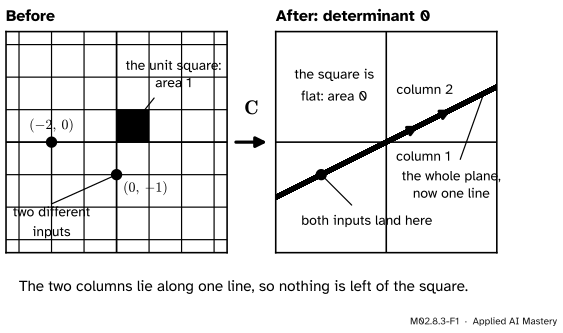
The map with matrix \(\mat{C}\). Its two columns, \({(1, 0.5)}\) and \({(2, 1)}\), point along the same line, so the unit square has nowhere to spread out. The whole plane lands on that line.
Three things have happened together. The determinant is zero. The two columns lie on one line. And two different inputs, \({(-2, 0)}\) and \({(0, -1)}\), have landed on the same output, \({(-2, -1)}\), so no map can send that output back to where it came from. The matrix has no inverse. In the language of solvers, it is singular.
This lesson shows that these three always come together, and then asks what the determinant does when one map follows another.
Build it up
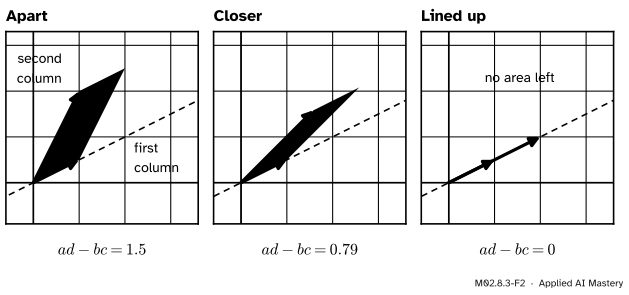
Step 1. Close the fan. Keep the first column of \(\mat{C}\) fixed and swing a second column towards its line.
M02.8.3-F2
As the second column swings onto the line of the first, the parallelogram closes like a fan. Its area reaches zero at the moment the columns line up, and not before.
Step 2. Lined up means dependent. Two vectors on one line through the origin are linearly dependent (lesson M02.2.3): one is a multiple of the other, and some combination of them with weights that are not both zero gives the zero vector. For \(\mat{C}\),
Step 3. Dependent means it cannot be undone. Read that combination as a matrix times a vector: \({\mat{C}\,(2, -1) = (0, 0)}\). But \({\mat{C}\,(0, 0) = (0, 0)}\) as well. Two different inputs share an output, so the map loses information, and a map can be undone only when it loses nothing (lesson M02.7.1).
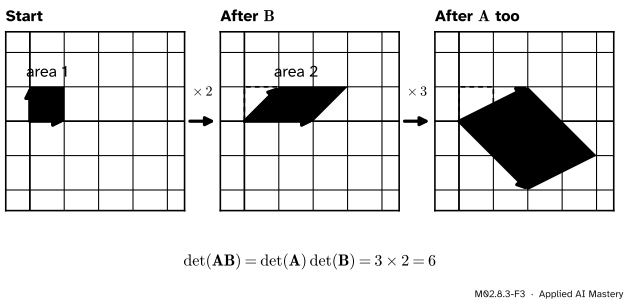
Step 4. One map after another. Suppose a map \(\mat{B}\) multiplies every area by 2, and a map \(\mat{A}\) multiplies every area by 3. Apply \(\mat{B}\), then \(\mat{A}\). A shape of area 1 has area 2 after the first map and area \({3 \times 2 = 6}\) after the second. The combined map is the product \(\mat{A}\mat{B}\) (lesson M02.5.1), so its area factor is the product of the two area factors. Signs behave the same way: each reversing map turns the plane over once, and two turns put it back. So determinants multiply:
Step 5. Once flat, always flat. If one map in a chain has determinant zero, the product has determinant zero, whatever the others do. A flattened plane cannot be inflated again.
The formal statement
NoteTheorem: zero determinant, dependent columns, no inverse
For a 2 by 2 matrix \({\mat{A} = \begin{bmatrix} a & b \\ c & d \end{bmatrix}}\), these three statements are either all true or all false:
\({\det \mat{A} = 0}\).
The columns of \(\mat{A}\) are linearly dependent.
\(\mat{A}\) has no inverse.
Proof. We show that 2 gives 1, that 1 gives 2, that 2 gives 3, and that if 1 is false then 3 is false.
2 gives 1. If the columns are dependent, one is a multiple of the other. Say \({(b, d) = k\,(a, c)}\). Then
\[
ad - bc = a\,(kc) - (ka)\,c = 0 .
\]
If instead \({(a, c) = k\,(b, d)}\), then \({ad - bc} = {(kb)\,d - b\,(kd)} = 0\) in the same way.
1 gives 2. Suppose \({ad - bc = 0}\). Try two combinations of the columns:
\[
\begin{aligned}
d \begin{bmatrix} a \\ c \end{bmatrix} - c \begin{bmatrix} b \\ d \end{bmatrix}
&= \begin{bmatrix} ad - bc \\ cd - cd \end{bmatrix} \\[4pt]
&= \begin{bmatrix} 0 \\ 0 \end{bmatrix}, \\[8pt]
-b \begin{bmatrix} a \\ c \end{bmatrix} + a \begin{bmatrix} b \\ d \end{bmatrix}
&= \begin{bmatrix} -ab + ab \\ ad - bc \end{bmatrix} \\[4pt]
&= \begin{bmatrix} 0 \\ 0 \end{bmatrix} .
\end{aligned}
\]
If any one of \({a, b, c, d}\) is not zero, one of these combinations has a weight that is not zero, and that is what dependent means. If all four are zero, both columns are the zero vector, which is dependent too.
2 gives 3. Dependent columns give weights \({x, y}\), not both zero, with \({x\,(a, c) + y\,(b, d)} = {(0, 0)}\). That says \({\mat{A}\,(x, y)} = {(0, 0)} = {\mat{A}\,(0, 0)}\). Two inputs share an output, so there is no inverse.
If 1 is false, 3 is false. Suppose \({ad - bc \neq 0}\). Lesson M02.7.1 found the inverse \({\frac{1}{ad - bc}\begin{bmatrix} d & -b \\ -c & a \end{bmatrix}}\). Check it by multiplying:
\[
\begin{aligned}
& \begin{bmatrix} a & b \\ c & d \end{bmatrix} \begin{bmatrix} d & -b \\ -c & a \end{bmatrix} \\[6pt]
&\quad = \begin{bmatrix} ad - bc & -ab + ba \\ cd - dc & -cb + da \end{bmatrix} \\[6pt]
&\quad = (ad - bc) \begin{bmatrix} 1 & 0 \\ 0 & 1 \end{bmatrix} .
\end{aligned}
\]
Multiplying in the other order gives the same result, so dividing by \({ad - bc}\), which is allowed because it is not zero, gives an inverse. That closes the circle. \(\blacksquare\)
The same is true in three dimensions, with volume in place of area: the box on three columns has zero volume exactly when the columns lie in one plane, which is when they are dependent. The go-deeper block of the last lesson shows why: the volume is the area of the base times the height, and it vanishes only if the base is flat or the remaining column lies in the plane of the base. In every dimension, a square matrix has an inverse exactly when its determinant is not zero.
NoteTheorem: the product rule
For square matrices \(\mat{A}\) and \(\mat{B}\) of the same size, \({\det(\mat{A}\mat{B})} = {\det(\mat{A}) \det(\mat{B})}\).
Step 4 gave the reason: scalings compose by multiplying. For 2 by 2 matrices we can also check it by algebra, every line shown. With \({\mat{B} = \begin{bmatrix} e & f \\ g & h \end{bmatrix}}\),
If \(\mat{A}\) triples every area, undoing it must shrink every area to a third.
The order does not matter to the determinant.\(\mat{A}\mat{B}\) and \(\mat{B}\mat{A}\) are usually different matrices, but \({\det(\mat{B}\mat{A})} = {\det(\mat{B})\det(\mat{A})} = {\det(\mat{A}\mat{B})}\), because numbers can be multiplied in either order.
The transpose. Swapping rows and columns turns \(\mat{A}\) into \({\mat{A}\T = \begin{bmatrix} a & c \\ b & d \end{bmatrix}}\), and
\[
\det(\mat{A}\T) = ad - cb = \det \mat{A} .
\]
M02.8.3-F5
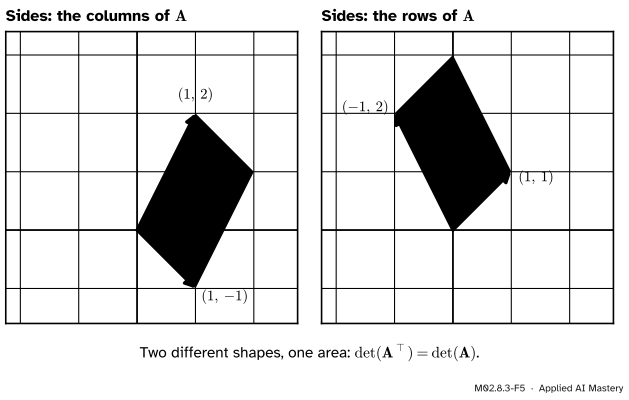
The columns of the matrix of \(T\) span one parallelogram and its rows span another. The shapes differ, and the areas are equal.
So everything this module says about columns is also true of rows: a matrix with dependent rows has determinant zero, and swapping two rows changes the sign. The transpose rule holds for square matrices of every size. The code below checks it for 3 by 3 matrices.
Worked example
Let \({\mat{A} = \begin{bmatrix} 1 & 1 \\ -1 & 2 \end{bmatrix}}\) be the matrix of \(T\) and \({\mat{B} = \begin{bmatrix} 2 & 1 \\ 0 & 1 \end{bmatrix}}\). Follow the unit square through \(\mat{B}\) and then \(\mat{A}\).
M02.8.3-F3
The unit square under \(\mat{B}\), then under \(\mat{A}\). The first map doubles its area and the second triples what it is given.
The two determinants.\({\det \mat{A} = 3}\) from the first lesson, and \({\det \mat{B}} = {2 \cdot 1 - 1 \cdot 0} = 2\).
The product. Each column of \(\mat{A}\mat{B}\) is \(\mat{A}\) applied to a column of \(\mat{B}\):
There is no single answer to give. A weight of 12 on the radius and 0 on the diameter fits both pizzas, and so does 0 on the radius and 6 on the diameter, and so does every blend of the two.
Explore
The area explorer in the last lesson shows a collapse as it happens. Press Collapse to load the pizza matrix \(\mat{C}\), then nudge one slider: the shaded cell opens up from nothing, and the read-out stops saying that the map cannot be undone. Then drag the second column back across the line of the first and watch the area pass through zero on its way from one sign to the other.
Pitfalls
M02.8.3-F4
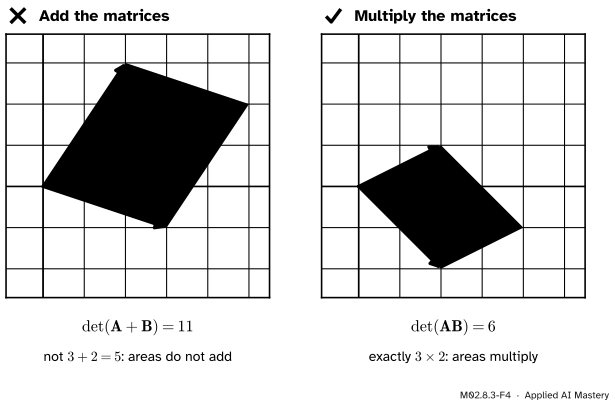
Wrong beside right, for the matrices of the worked example. Adding two matrices does not add their determinants. Multiplying two matrices does multiply them.
“The determinant of a sum is the sum of the determinants.”
It is not. Here \({\det \mat{A} + \det \mat{B}} = {3 + 2} = 5\), but \({\mat{A} + \mat{B} = \begin{bmatrix} 3 & 2 \\ -1 & 3 \end{bmatrix}}\) has determinant \({9 + 2 = 11}\). The determinant respects products, not sums.
“Determinant zero means the matrix is all zeros.”
The pizza matrix has no zero entry at all, and its determinant is zero. What matters is not the size of the entries but whether the columns line up. Only the zero matrix sends everything to the origin; a matrix like \(\mat{C}\) keeps a whole line.
“Two columns that carry the same information do no harm.”
In a table of data they make the columns dependent, and then any method that must undo the table’s matrix fails or returns nonsense. Radius and diameter, or a price in pounds and the same price in pence, are one measurement written twice. Drop one of the pair before fitting.
Check yourself
Recall
1. Which three statements about a 2 by 2 matrix are always true together or false together?
Show answer
Its determinant is zero; its columns are linearly dependent (they lie on one line); it has no inverse.
2. What does a map with determinant zero do to the plane?
Show answer
It squashes the whole plane onto a line through the origin, or onto the origin alone. Every area becomes zero.
3. State the product rule, and give the reason in one sentence.
Show answer
\({\det(\mat{A}\mat{B})} = {\det(\mat{A})\det(\mat{B})}\). Applying one map after another scales areas by one factor and then by the other, so the factors multiply.
4. What is the determinant of the inverse of a matrix?
Show answer
\({1 / \det \mat{A}}\), because \({\det(\mat{A})\det(\mat{A}^{-1})} = \det\) of the identity \({= 1}\).
5. How does the determinant of the transpose compare with the determinant of the matrix?
Show answer
They are equal. So rows can be used in place of columns in every statement about determinants.
Exercises
1.★ Which of these matrices have an inverse? (a) \(\begin{bmatrix} 2 & 6 \\ 1 & 3 \end{bmatrix}\) (b) \(\begin{bmatrix} 2 & 5 \\ 1 & 3 \end{bmatrix}\) (c) \(\begin{bmatrix} 0 & 2 \\ 0 & 7 \end{bmatrix}\)
Show solution
(a) \({2 \cdot 3 - 6 \cdot 1 = 0}\). No inverse: the second column is 3 times the first.
(b) \({2 \cdot 3 - 5 \cdot 1 = 1}\). It has an inverse, and the inverse has determinant \({1/1 = 1}\).
(c) \({0 \cdot 7 - 2 \cdot 0 = 0}\). No inverse: the first column is the zero vector, so the columns are dependent.
2.★★\(\mat{A}\) and \(\mat{B}\) are 2 by 2 matrices with \({\det \mat{A} = 3}\) and \({\det \mat{B} = -2}\). Find the determinants of \(\mat{A}\mat{B}\), \({\mat{A}^{-1}}\), \(\mat{A}^2\mat{B}\), \(\mat{B}\T\mat{A}\) and \(2\mat{A}\). Does \(\mat{A}\mat{B}\) keep orientation?
\({\det(2\mat{A})} = {2^2 \times 3} = 12\), by the scaling rule of the first lesson.
\(\mat{A}\mat{B}\) has a negative determinant, so it reverses orientation: one of the two maps flips the plane and the other does not.
3.★★★ A square matrix \(\mat{Q}\) satisfies \({\mat{Q}\T\mat{Q} = \mat{I}}\), the identity. Show that \(\det \mat{Q}\) is \(1\) or \({-1}\). What does that say about the map?
Show solution
Take the determinant of both sides. By the product rule and the transpose rule,
and the right-hand side is \({\det \mat{I} = 1}\). So \({(\det \mat{Q})^2 = 1}\), which gives \({\det \mat{Q} = 1}\) or \({-1}\). Such a map changes no area. Rotations are examples with determinant \(1\) and mirrors are examples with determinant \({-1}\). Module M02.10 studies these matrices.
Summary card
Determinant zero means the map has squashed space flat and cannot be undone.
M02.8.3-F1
Columns on one line: area zero.
Collapse.\({\det \mat{A} = 0}\) exactly when the columns are dependent, exactly when \(\mat{A}\) has no inverse.
Inverse and transpose.\({\det(\mat{A}^{-1}) = 1/\det \mat{A}}\) and \({\det(\mat{A}\T) = \det \mat{A}}\).
Not a rule.\({\det(\mat{A} + \mat{B})}\) is not \({\det \mat{A} + \det \mat{B}}\).
Sources and next steps
Sources. Each was opened and checked against this lesson on 12 November 2026.
Dan Margalit and Joseph Rabinoff, Interactive Linear Algebra, Section 4.1, Determinants: Definition (open textbook). The invertibility property (a square matrix is invertible if and only if its determinant is not zero), the multiplicativity property, the transpose property, and the corollary \({\det(\mat{A}^{-1})} = {1/\det(\mat{A})}\). Section 4.3 gives the geometric reason for multiplicativity of the absolute value of the determinant, used in Step 4: composing two maps scales volumes by one factor and then the other.
Gilbert Strang, Properties of determinants, MIT OpenCourseWare 18.06SC, lecture summary. Property 8, the determinant is zero exactly when the matrix is singular; property 9, the product rule, with the warning that the determinant of a sum is not the sum of the determinants, and \({\det \mat{A}^{-1} = 1/\det \mat{A}}\); property 10, \({\det \mat{A}\T = \det \mat{A}}\).
Grant Sanderson, The determinant, 3Blue1Brown, Linear Algebra, chapter 6. The determinant is zero when the map squashes space into a smaller dimension, and the product rule is posed there as a puzzle to explain in one sentence.
Next.M02.8.4 Determinants in practice shows how determinants are computed for large matrices, and where they turn up in probability.