A negative determinant means the map has turned the plane over, like a mirror. Learn to read orientation from the columns of a matrix, then move up a dimension: the 3 by 3 determinant is a signed volume factor, computed by cofactor expansion.
Explain what the sign of a determinant says about a map: orientation kept or orientation reversed.
Read the sign of a 2 by 2 determinant from the direction of the short turn from the first column to the second.
Compute a 3 by 3 determinant by cofactor expansion along the first row, with the signs plus, minus, plus.
Interpret a 3 by 3 determinant as the signed volume factor of the box spanned by the columns.
In review. The maths and code on this page are checked by automated tests on every change, but an independent reader has not signed it off yet. Spot a mistake or a confusing step? Tell us.
The question
Hold your right hand up to a mirror and the hand in the glass is a left hand. No amount of turning makes a left glove fit a right hand. Some matrices only turn and stretch the plane. Others turn it over, as the mirror does. The formula \({ad - bc}\) sometimes comes out negative. Is that the mirror speaking? And what replaces area when the unit square becomes a unit cube?
From the last lesson
1. What is the determinant of \(\begin{bmatrix} a & b \\ c & d \end{bmatrix}\), and how is it related to the area factor?
Show answer
\({\det \mat{A} = ad - bc}\). The area factor is its absolute value, \({\abs{ad - bc}}\).
2. Which parallelogram has the area \({\abs{ad - bc}}\)?
Show answer
The one spanned by the columns \({(a, c)}\) and \({(b, d)}\) of the matrix: the image of the unit square.
Intuition
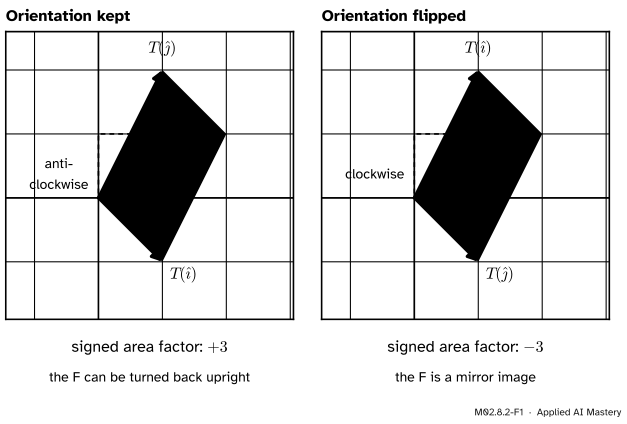
Build two matrices from the same two arrows, \({(1, -1)}\) and \({(1, 2)}\). The first is our map \(T\), with \({(1, -1)}\) as its first column. The second puts the arrows in the other order. Both send the unit square to the same parallelogram, of area 3. Now draw a letter F inside the square.
M02.8.2-F1
The same two arrows in the two possible orders. On the left the F is slanted, and turning the page would make it readable. On the right it is a mirror image, and no turning will help.
Area cannot tell these two maps apart: both multiply it by 3. The formula can:
The size of the determinant is the area factor. Its sign says whether the plane has been turned over. A map that turns the plane over is said to reverse orientation.
Build it up
Step 1. Orientation, by eye. Before any map, the short turn from \(\ihat\) to \(\jhat\) is a quarter-turn anticlockwise. After the map, look at the short turn from \(T(\ihat)\) to \(T(\jhat)\), the one of less than half a turn. If it is still anticlockwise, orientation is kept. If it is clockwise, the plane has been flipped. The green arcs in the figure show the two cases.
Step 2. The formula already knows. Write \({\vect{u} = (a, c)}\) and \({\vect{v} = (b, d)}\) for the columns. The last lesson found that
\[
ad - bc \;=\; \vect{v} \cdot \vect{n},
\]
where \({\vect{n} = (-c, a)}\) is \(\vect{u}\) turned a quarter-turn anticlockwise. So \(\vect{n}\) points to the anticlockwise side of \(\vect{u}\). A dot product is positive when the two vectors point to the same side, with less than a right angle between them, negative when they point to opposite sides, and zero when they are perpendicular (lesson M02.3.3). Read that off for \({\vect{v} \cdot \vect{n}}\):
M02.8.2-F2
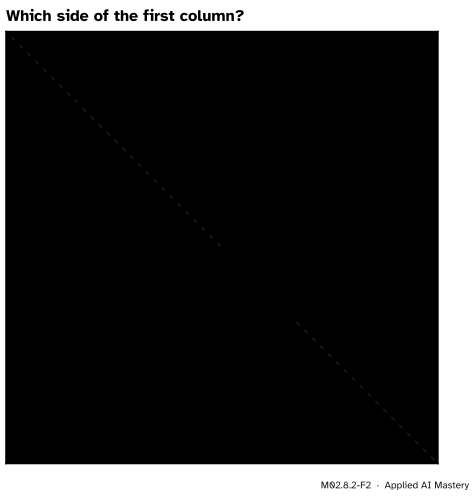
The line through the first column splits the plane. The sign of \({ad - bc}\) says on which side the second column has landed.
\({ad - bc > 0}\): the second column is on the anticlockwise side of the first. Orientation is kept.
\({ad - bc < 0}\): it is on the clockwise side. Orientation is reversed.
\({ad - bc = 0}\): it lies along the line of the first column. The parallelogram is flat, which is the subject of the next lesson.
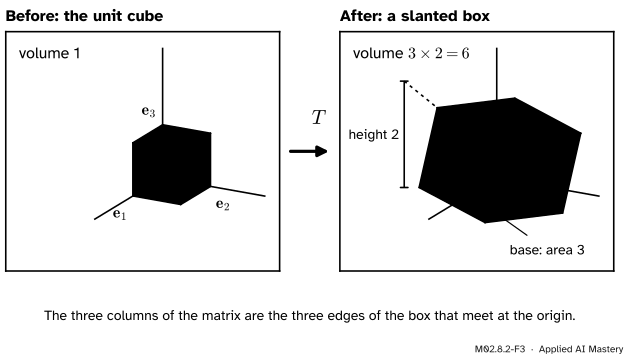
Step 3. Up one dimension. A 3 by 3 matrix records where the three basis vectors \({\vect{e}_1, \vect{e}_2, \vect{e}_3}\) of space land, one per column (lesson M02.4.4). The unit cube lands on the slanted box that has those three columns as edges. The argument of the last lesson goes through with small cubes in place of small squares, so a linear map of space multiplies every volume by the same number: the volume of that box.
M02.8.2-F3
The matrix with columns \({(1, -1, 0)}\), \({(1, 2, 0)}\) and \({(1, 1, 2)}\). The first two columns lie on the floor and span the parallelogram of \(T\), of area 3. The third rises to height 2.
For this box the volume can be found without any new formula. Its base is the parallelogram of the last lesson, of area 3. Its top is at height 2. The box leans, but leaning does not change a volume, just as pushing a stack of paper sideways does not: every sheet keeps its area. So the volume is base times height, \({3 \times 2 = 6}\).
Step 4. Orientation in space. Point the first finger of your right hand along the first column and the middle finger along the second. If your thumb can then point along the third, the three columns are right-handed, like \({\vect{e}_1, \vect{e}_2, \vect{e}_3}\) themselves. If you need your left hand, the map has turned space inside out, as a mirror does. The determinant of a 3 by 3 matrix is built to be positive in the first case and negative in the second.
The formal statement
NoteDefinition: the determinant as a signed factor
For a 2 by 2 matrix, \({\det \mat{A} = ad - bc}\). Its absolute value is the area factor of the map. Its sign is positive when the map keeps orientation and negative when it reverses it.
For a 3 by 3 matrix, the determinant is defined by cofactor expansion along the first row:
Its absolute value is the volume factor of the map, and its sign records orientation.
Each small determinant is called a minor: the determinant of what is left of the matrix when the row and the column of the entry in front of it are struck out. The signs go plus, minus, plus. A minor together with its sign is called a cofactor.
Two facts about the sign, derived.
Swapping the two columns reverses the sign. The swapped matrix is \(\begin{bmatrix} b & a \\ d & c \end{bmatrix}\), and its determinant is \({bc - ad} = {-(ad - bc)}\). That is the pair of maps in the anchor figure.
A rotation keeps orientation and a mirror reverses it. A rotation has determinant \({\cos^2\theta + \sin^2\theta = 1}\). The mirror \({\begin{bmatrix} -1 & 0 \\ 0 & 1 \end{bmatrix}}\), which sends \({(x, y)}\) to \({(-x, y)}\), has determinant \({(-1)(1) - 0 = -1}\): areas are unchanged and the plane is turned over.
Two checks of the 3 by 3 rule against volumes we already know.
A box with sides \(p\), \(q\), \(r\) along the axes comes from the matrix with \({p, q, r}\) on its diagonal and zeros elsewhere. The rule gives \({p\,(qr - 0) - 0 + 0} = pqr\), the volume of the box.
which is the \({3 \times 2}\) read off the picture.
Go deeper: why the cofactor rule measures volume
Call the columns \(\vect{u}\), \(\vect{v}\), \(\vect{w}\). Take the parallelogram spanned by \(\vect{v}\) and \(\vect{w}\) as the base of the box, and build a vector from three 2 by 2 determinants:
The six terms cancel in pairs. The same happens for \({\vect{n} \cdot \vect{w}}\).
Its length is the area of the base. Let \(\theta\) be the angle between \(\vect{v}\) and \(\vect{w}\). Take \(\vect{v}\) as one side of the base parallelogram, of length \(\norm{\vect{v}}\). The tip of \(\vect{w}\) is \(\norm{\vect{w}} \sin\theta\) away from the line of \(\vect{v}\), so side times height gives the area \({\norm{\vect{v}}\,\norm{\vect{w}} \sin\theta}\). Squaring, and using \({\vect{v} \cdot \vect{w} = \norm{\vect{v}}\,\norm{\vect{w}}\cos\theta}\) from lesson M02.3.1,
Squaring the three entries of \(\vect{n}\) and adding gives exactly the same expression. So \(\norm{\vect{n}}\) is the area of the base.
Volume is base times height. The height of the box is how far \(\vect{u}\) reaches along \(\vect{n}\), which is \({\abs{\vect{u} \cdot \vect{n}} / \norm{\vect{n}}}\) by the projection formula. So
(If \({\norm{\vect{n}} = 0}\) the base is flat, the volume is 0, and \({\vect{u} \cdot \vect{n} = 0}\) too.)
And \({\vect{u} \cdot \vect{n}}\) is the cofactor rule. With \({\vect{u} = (a_{11}, a_{21}, a_{31})}\), \({\vect{v} = (a_{12}, a_{22}, a_{32})}\) and \({\vect{w} = (a_{13}, a_{23}, a_{33})}\),
Multiplying out the first-row rule of the definition gives the same six products with the same signs. So the rule computes \({\vect{u} \cdot \vect{n}}\), whose absolute value is the volume.
The grouping above, by the entries of the first column, is called expansion down the first column. It is a general fact that expanding along any row or any column gives the same number, provided each term takes its sign from the checkerboard in the pitfalls figure below.
Worked example
Find the determinant of \({\mat{W} = \begin{bmatrix} 2 & 1 & 3 \\ 0 & -1 & 4 \\ 1 & 2 & 1 \end{bmatrix}}\) and say what it means.
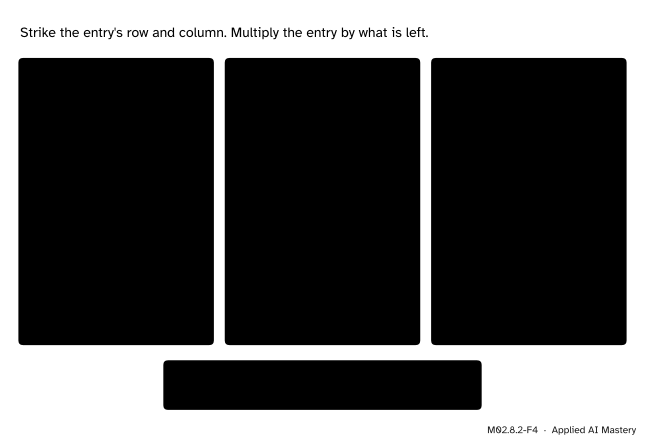
Go along the first row. For each entry, strike out its row and its column, take the determinant of the four numbers that are left, and attach the sign.
M02.8.2-F4
Cofactor expansion along the first row. Each card handles one entry of that row: the entry in blue, its struck-out row and column in grey, and its minor in yellow.
What it means. The map multiplies every volume by 11, and the minus sign says it reverses orientation: the three columns \({(2, 0, 1)}\), \({(1, -1, 2)}\), \({(3, 4, 1)}\), in that order, are left-handed.
A second route, as a check. Expand down the first column instead. Its entries are \({2, 0, 1}\), with signs plus, minus, plus:
The rule of Step 1, as a function: which way is the short turn from one arrow to another?
def short_turn(u, v): side = u[0] * v[1] - v[0] * u[1] # ad - bc for the columns u and vif side >0:return"anticlockwise"return"clockwise"if side <0else"none: same line"print(short_turn((1, -1), (1, 2)), "|", short_turn((1, 2), (1, -1)), "|", short_turn((1, 2), (2, 4)))
anticlockwise | clockwise | none: same line
The library version works for any size. Swapping two columns flips the sign in three dimensions as well.
import numpy as npW = np.array(W, dtype=float)swapped = W[:, [1, 0, 2]] # the first two columns exchangedprint(round(np.linalg.det(W), 6), round(np.linalg.det(swapped), 6))theta = np.radians(30)rotation = np.array([[np.cos(theta), -np.sin(theta)], [np.sin(theta), np.cos(theta)]])mirror = np.array([[-1.0, 0.0], [0.0, 1.0]])turn, flip = np.linalg.det(rotation), np.linalg.det(mirror)print(round(turn, 6), round(flip, 6))
-11.0 11.0
1.0 -1.0
Explore
M02.8-X1
Area explorer
Drag the two round handles to choose the columns of a matrix. The shaded shape is the image of the unit square, and the read-out gives its signed area. Every handle also has a slider, so the keyboard works too.
Things to try:
Press The course’s T. The read-out should say \({+3.00}\). Now press Swap the columns and watch the sign, the colour and the letter F change while the shape stays put.
Press Turn the second column several times, or Play a full turn. At which two moments is the signed area zero? Where is the second column then?
Drag the second column slowly across the line of the first. The area shrinks to nothing, and comes back with the other sign and the other colour.
Find a matrix with determinant exactly \({-1}\) that is not a simple mirror in an axis.
Press Shear, then move only the x slider of the second column. Why does the area not change?
Pitfalls
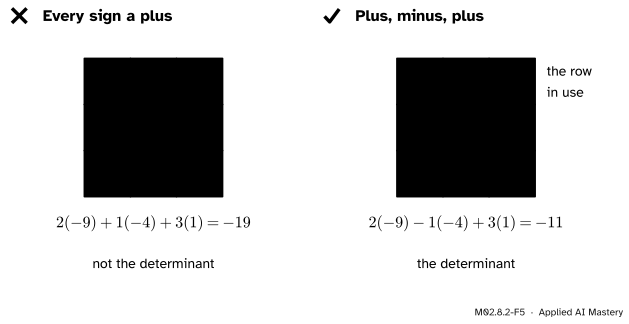
M02.8.2-F5
Wrong beside right, for the worked example. The signs of a cofactor expansion follow a checkerboard that starts with a plus in the top-left corner.
“Every term of the expansion is added.”
The middle term of the first row is subtracted. With all plus signs the worked example gives \({-19}\) in place of \({-11}\). The sign of the term for the entry in row \(i\) and column \(j\) is plus when \({i + j}\) is even and minus when it is odd, which is the checkerboard in the figure.
“A negative determinant means the shape shrinks.”
Shrinking is about size: a determinant of \(0.5\) halves every area. A determinant of \({-3}\) makes every area three times larger and turns the plane over. Read the size and the sign separately.
“Flipping the training images is always a harmless way to get more data.”
A left-to-right flip is the map \({(x, y) \mapsto (-x, y)}\), with determinant \({-1}\). A mirrored cat is still a cat, so for many photographs the flip is a good trick. But it reverses orientation, and some things depend on orientation: a mirrored “b” is a “d”, and mirrored text is not text a reader will ever meet. Whether to use a flip depends on whether the labels survive a mirror.
Check yourself
Recall
1. What do the size and the sign of a 2 by 2 determinant each tell you?
Show answer
The size is the area factor. The sign is positive when the map keeps orientation and negative when it turns the plane over.
2. How can you read the sign from the two columns without computing anything?
Show answer
Look at the short turn from the first column to the second. Anticlockwise means positive, clockwise means negative, and no turn at all (same line) means zero.
3. What happens to the determinant when the two columns of a matrix are swapped?
Show answer
It changes sign and keeps its size: \({bc - ad} = {-(ad - bc)}\).
4. What does the absolute value of a 3 by 3 determinant measure?
Show answer
The volume factor of the map: the volume of the slanted box whose edges are the three columns, which is the image of the unit cube.
5. In a cofactor expansion along the first row, what are the signs of the three terms, and what is a minor?
Show answer
Plus, minus, plus. The minor of an entry is the determinant of what is left when that entry’s row and column are struck out.
Exercises
1.★ For each matrix, give the area factor and say whether orientation is kept. (a) \(\begin{bmatrix} 2 & 1 \\ 1 & 3 \end{bmatrix}\) (b) \(\begin{bmatrix} 0 & 1 \\ 1 & 0 \end{bmatrix}\) (c) \(\begin{bmatrix} 1 & 2 \\ 3 & 4 \end{bmatrix}\)
(b) \({0 \cdot 0 - 1 \cdot 1 = -1}\). Area factor 1, orientation reversed. This map swaps the two coordinates, which is a mirror in the line \({y = x}\).
2.★★ Change one entry of the slanted box of this lesson to get \({\begin{bmatrix} 1 & 1 & 1 \\ -1 & 2 & 1 \\ 1 & 0 & 2 \end{bmatrix}}\). Find its determinant by expanding along the first row.
3.★★★ Show that swapping the first two columns of any 3 by 3 matrix reverses the sign of its determinant.
Show solution
After the swap, the first row reads \({a_{12}, a_{11}, a_{13}}\), and in every minor the two swapped columns have changed places too. Expand along the first row:
The first two terms have exchanged places and signs, and the bracket of the third term has reversed. Every term is the negative of a term of the original, so the whole determinant changes sign. In the hand picture, swapping two columns swaps two fingers, which turns a right hand into a left hand.
Summary card
The size of a determinant is the area or volume factor. Its sign says whether space was turned over.
By eye. Short turn from the first column to the second: anticlockwise is positive.
Swap two columns. The determinant changes sign.
3 by 3.\({\det \mat{A}} = {a_{11}M_{11}} - {a_{12}M_{12}} + {a_{13}M_{13}}\), where \(M_{1j}\) is the minor of \(a_{1j}\).
Sources and next steps
Sources. Each was opened and checked against this lesson on 12 November 2026.
Grant Sanderson, The determinant, 3Blue1Brown, Linear Algebra, chapter 6. Maps that flip the plane “invert the orientation of space” and have a negative determinant; in three dimensions the determinant is the volume of the parallelepiped that the unit cube turns into, with orientation described by the right-hand rule.
Dan Margalit and Joseph Rabinoff, Interactive Linear Algebra, Section 4.2, Cofactor Expansions (open textbook). The definitions of minor and cofactor, with the sign \({(-1)^{i+j}}\), and the theorem that expanding along any row or column gives the same number. The book calls the smaller matrix itself the minor; this lesson uses the word for its determinant, which is the more common usage. Section 4.3 gives the theorem that the absolute value of the determinant is the volume of the parallelepiped.
Gilbert Strang, Determinant formulas and cofactors, MIT OpenCourseWare 18.06SC, lecture summary. The 3 by 3 cofactor formula along the first row and the six-product “big formula” that the go-deeper block multiplies out.
Next.M02.8.3 Zero means collapse looks at the case between positive and negative, where the parallelogram closes up.